Love and Sword: A Dream of Jianghu
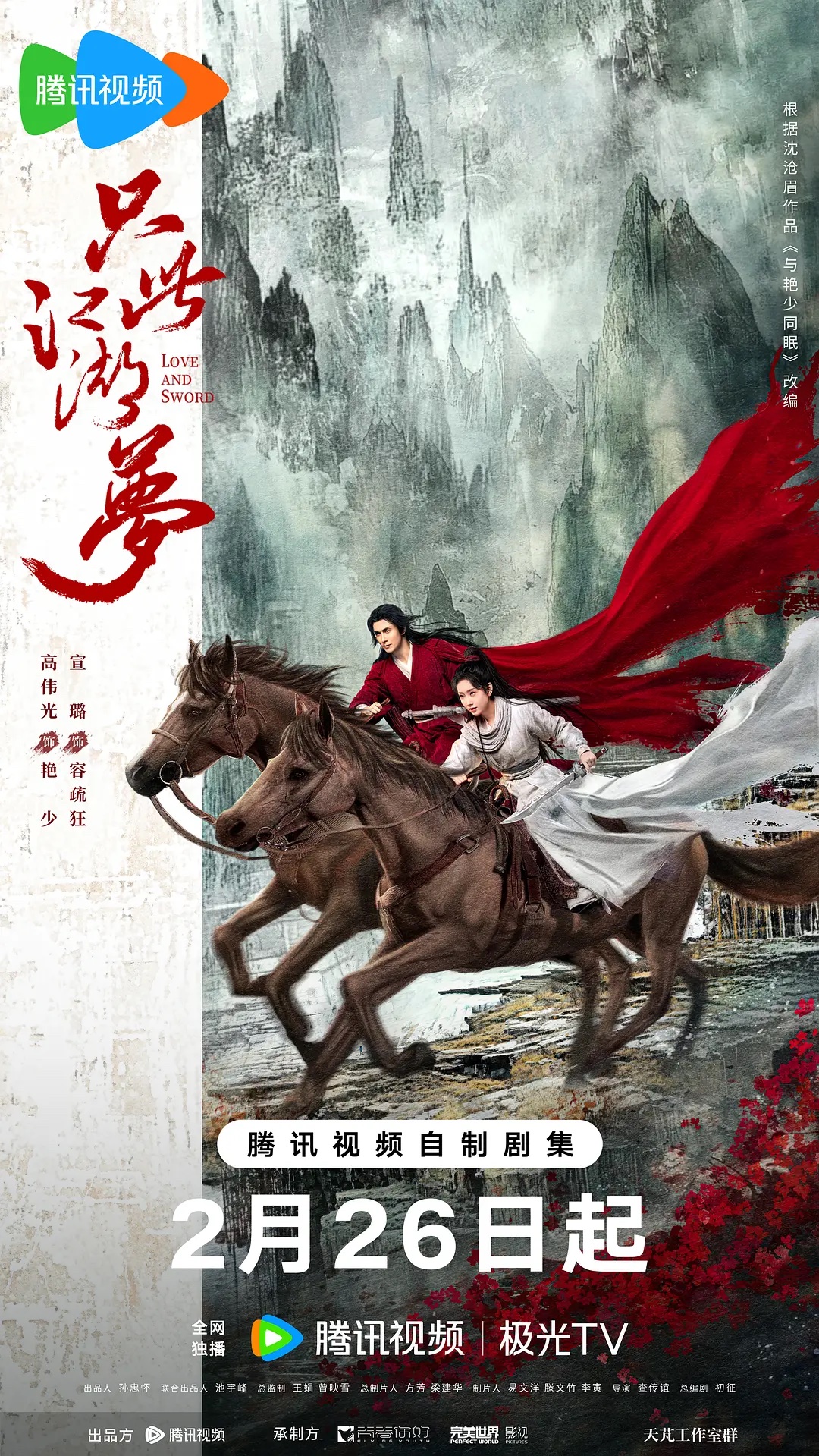 Love and Sword (directed by Cha Zhuanyi, starring Xuan Lu, Gao Weiguang), is a Tencent wuxia romance series released earlier this year. Loosely a chuanyue (Chinese for isekai) story, its protagonist Fang Yi, a young woman in contemporary China, gets transported into a dream world after being in a road accident. The woman with whom she shares her name, whose body she ends up in, is one of the greatest fighters of the land. She is being held to ransom within an inch of her life, and rescued by the dashing swordsman Yanshao (literally “dashing youth”), on a white horse. They make a hazardous journey back to her clan. At first, our heroine is anxious to get home, but as she recovers fragments of traumatic memory of her world and bonds with the people of this one, she begins to like it here, rather a lot.
Sound like a typical wuxia story? Well, it’s meant to be. The show doesn’t hide the fact it’s a dynastic world of the wuxia imagination, adopting an only slightly more sophisticated title of “A Mere Dream of Jianghu” than the novel it’s based on “Sleeping with Yanshao”. And it delivers all the romance, excitement and mystery that we typically find in wuxia novels. This is precisely why I am writing about it, from its archetypal trappings, characterisation and tropey plot developments, we can see much of what makes wuxia storytelling appeal to us, and therefore popular, and the genre as it is today. As an enthusiast who grew up with wuxia TV, went on the read the novels, and now write about it as an author, I’ll be tapping into my considerable research (recently more focussed and academic). Heads up that because I’m taking the story apart, there will be spoilers.
Let’s begin with the settings and set-ups. It’s got all the major ones. First and foremost, wulin, the martial artists circle, with six competing major clans such as the Junshan, presided over by the leading one, Yuchi Villa, plotted against by the infamous one, Guigu, and occasionally mediated by the mysterious sect that rarely emerges in public, Tiangang. Classic wulin wouldn’t be complete without the Tang Sect, which of course, is one of the major powers here. Originating from legends of the real Tang Family Fort in Sichuan, which made it into the novels of Bai Gongyu, Zhao Zhengyin in the 1930s and ‘40s, the mechanical contraptions, stealth weapons and poisons of Tangmen唐门 featured prominently in the works of the Four Great Classic Masters, especially Gu Long and Wen Rui’an, and subsequently across stories by different authors, becoming instantly recognisable for any Wuxia enthusiastic, and still present in contemporary novels like Blood of Youth and Douluo Continent.
The action in Love and Sword, is played out in some of the most common jianghu landscape, the cliffs and caves, and the desert and remote plains. The caves act as an apt training ground, quiet and away from the distractions of society, for martial artists, whereas clifftop encounters signify the desperate fight or combat of the last resort that usually leads to turns in the plot. When Rong Shukuang (the heroine’s other name) and her friends are intercepted on their way to Tiangang by Wuwang assassins, the ensuing battle ends with three of the main characters, Rong, Yanshao and Shen Zuitian, falling off the cliff into the river below. As it usually pans out, if they’re alive, they end up stuck together in a cave. In this case, these scenes enable the love interests to reveal their care for each other, show compassion for the injured villain, whose other side emerges, laying the path for his transition to antagonist while the plot thickens around the real baddie.
The dessert and remote plains provide another space for the wandering swordsmen and women to roam, and magnificent backdrops for the fights. The desert in this story, hosts a ransom and rescue, a culturally diverse oasis, and Wuqing (Loveless) Tavern, a sanctuary for swordsmen where jianghu rules override everything, and everyone must leave all their weapons (and disputes) at the door.
The structure of the story follows the course of some of the key narrative modes of Wuxia. The main one is the treasure hunt, much of plot is driven forwards by those seeking a collection of treasure, and those who guard it. Of course, when it’s finally found, the chamber contains not gems, but martial arts manuals, often the prized above any jewel in the wuxia world. This is narrative framework is supplemented by revenge mode, its agent being Liu An, a handmaid of Yuchi who is secretly someone presumed dead from Rong’s hometown where a massacre was perpetrated a long time ago. Now a Wuwuang assassin, Liu lies in wait for the ripe opportunity to avenge her family. These two traditional frameworks have been with wuxia before it became a literary genre, whereas the third one, detective mode, was introduced by mid-20th century authors, Gu Long in particular, who infused elements of Western thrillers and mysteries into the genre. The sustained suspense draws readers on as the characters gradually unravel the deepening mystery, discover dark secrets from the past, usually the chaotic mess left by the older generation that our young protagonists must sort through. In this case, these secrets relate to Rong’s real identity and the reason for the massacre.
 Almost all the main characters in Love and Sword are archetypes, the protagonist Rong Shukuang is the androgynous swordswoman who bests all her male counterparts in scholarly and martial arts, with the typical backstory of the orphan raised in a big household. She even comes with the complimentary sidekick, Tang Yingluo, the herbalist and toxicologist. Whereas Yanshao is the spitting image of the handsome but aloof male hero, Lin Shaoci, eldest son to the Chief of Yuchi Villa, represents the genteel and personable (“lady magnet”) xia. We’ve also got the Wang Linglong, the bratty princess from the Tang sect, Lin Wanci, Shaoci’s younger sister, the fragile and sickly schemer. As for the eccentrics of jianghu, the range runs from Shen Zuitian, head of the illegitimate Guigu Sect, practitioner of dark arts, his strange stooges, to Jin Buyao, the morally ambivalent innkeeper and the shady regulars of Loveless Tavern. Together they weave a convincing jianghu dreamworld for Fang Yi, who is in a coma in her world, while experiencing this one.
This being the world of the wuxia geek’s dream, it won’t be complete without the well-choreographed fights, which do indeed, pepper the series within the recognisable iconography, from the signature rooftop chases, to the rain-drenched dance-like sparring with assassins in high contract colours (hallmark of post-Zhang Yimou wuxia), to the timeless tavern fight complete with flying tables and bathtubs. The romantic moments in wuxia fiction often occur when the heroes battle side by side, or combine their techniques as one. Albeit in a rather tawdry fashion, the series obliges with a scene when Yanshao teaches martial arts to Shukuang.
It’s clear that the female author Shen Cangmei grew up reading classic wuxia and the novel contains considerable amounts of self-insertion. It doesn’t have the alternate title of Tale of a Geek Girl in Jianghu for nothing. After all, the heroine even quotes Gu Long at one point. But one major way in which this wishful dream fulfilment differs from the male-centric world of classic wuxia, is much better female characterisation. Because the series has three women in the writer’s chair (novelist and scriptwriters), they can write non-martial characters like Yingluo who also progress, complex female villains like Wanci, subvert the stereotype of gullible female warriors who fall apart for love (Tang Chanyi), and add nuances to the “strong” female heroine by putting the head of a playful, resourceful modern-day business woman into the body of the formidable and blustery Rong Shukuang. And they do.
The imbalance in the display of martial prowess between the male and female heroes seems incongruous with the overall tone of the story, whether it’s in the novel or down to the heteronormative directive currently in mainstream Chinese media, would require further explorations. A lot of well-written Wuxia fiction bears analysis for profound sociopolitical, cultural and literary worth (or I wouldn’t be writing a book about it). But for what it is, Love and Sword stands right in the middle of the contemporary wuxia discourse in China, where jianghu has become rather meta, a non-present but assumed backdrop, a metaphor for the real world, or an alternate dream-like or gamified dimension which allows protagonists to break the fourth wall, acting as an extension their psyche. Even though Fang Yi eventually returns to her own world, and finds someone in her life that looks exactly like Yanshao, they still go on trips to the dessert and take photos in cosplay. Although they’re no longer clanned fighters in dynastic China, they carry the spirit with them. As per the closing words of the show, “jianghu is in our hearts”.
Posted in Articles and tagged chinese drama, fiction, jianghu, martial arts fantasy, novel, TV, Wuxia