Mesmerising Mythical Mayhem: Jentry Chau V.s The Underworld Part 1
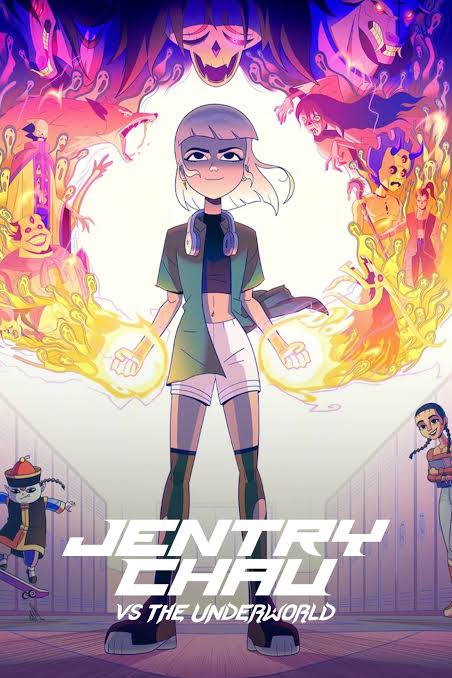 There have been a slew of fantastic YA animation projects recently that have captured fan’s hearts, such as She-Ra, Kipo and the Age of Wonderbeasts and The Owl House, all of which I have loved, but none of them grabbed me by the face, and screamed at me “this has been made for you”, in the way that Jentry Chau vs the Underworld did. My excitement for the project was lit the moment I saw the announcement images and teasers, and I began to talk about it on social media, but duties and deadlines actually stopped me from sitting down and watching the show until Spring Festival. I was blown away, and consumed the whole thing in a couple of days. Like any rich banquet devoured so greedily, I knew I would have to sit and digest it before being able to convey how much I enjoyed it.
First, let’s discuss the landscape the perfect storm this show has found itself inhabiting. While Jentry hit streaming at the very end of 2024, it was still in the space to ride a cultural wave of Modern Asian Experience v.s Ancient Lore. 2025 produced two animated films which broke various records, and became Cultural Phenomenon, Enlight Pictures’ Nehza 2, and Netflix’s K-Pop Demon Hunters. These films obviously had no effect on the making of Jentry, but they have certainly elevated how I talk about it. No longer am I saying, as a quiet cultural commentator, “here’s a fascinating series blending Chinese mythology with the struggles of cross-cultural upbringing”, I can now be a howling fangirl to people quietly humming Golden, or hanging Nehza charms off their bags, “for heaven’s sake, sit down and watch this goddamned show!”
The tone is set from the very start. A banger of an opening from K-style girl group Katseye, who are the perfect pan-Asian-American mix to capture the forces Jentry feels pulling on her throughout the series. The colourful, punky comic visuals, mixed with Mandarin-peppered rap, set up the vibe. The series is certainly worthy of the Emmy it garnered. The Texan-born Jentry is an orphan raised first by her great aunt Flora Chau, before being sent to live in Korea with a family friend. The 16-year-old finds herself attacked by supernatural assailants, and for her own safety, is uprooted once more, from friends, school and comfort, to settle into a new high school, deal with relationships and destructive legacies, all on top of getting to grips with powers she never wanted, in order to close a portal to the underworld. It’s a lot, and navigating in an environment where trust and stability are being constantly undermined, felt like something far too relatable.
 As the writer of two books on Chinese mythology, I always get a buzz out of imaginative renditions of mythical beings and creative interpretations of deities, especially when, at their core, they demonstrate real understanding of the traditions behind them. While I know everyone wants to hear about Ed, the Jiangshi with a Twilight/Clout obsession, I’d like to concentrate on some of the background characters, who people may not realise are truly deep cuts.
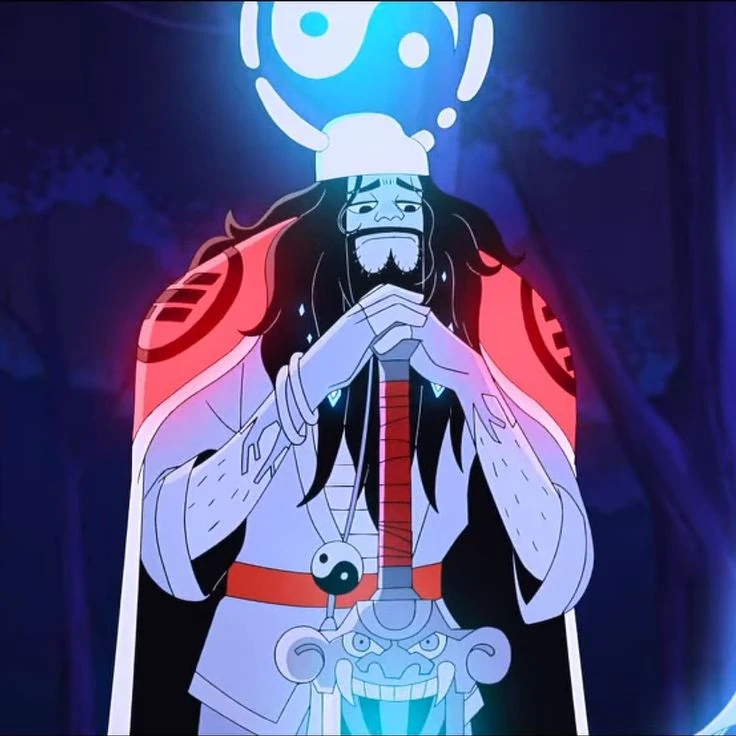
Starting with the laid back, scruffy demon hunter, who is initially introduced without a name, but still had me pointing to the screen like the DiCaprio meme. The demonic demon hunter, Zhong Kui, appears with his traditional imposing stature, hirsuteness and ungainliness, but has the presence of bandit chief, his official’s uniform now in tatters, the hat drawn more like a bandana. Though his huge sword, bagua cape and the glowing beads braided into his beard demonstrate his obvious power, he is depicted with his usual melancholic face, his slow shamble belieing his sadness. Never attaining the scholarly success due to him in life, Zhong Kui is doomed to wander the world, hunting stray ghosts. This fresh take of him as a ‘The Dude’ style character, happy to do the odd favour, until you break one of the rules of the underworld, at which point his justice descends, swift and merciless, works well with the passionate and irreverent nature of his origins, without making him a caricature.
Zhong Kui has enjoyed many excellent interpretations through Sinophone cinema and games, so whilst it was fun to see him, what was even more impactful was the appearance of Horse-Face and Ox-Head. According to Chinese lore, the two were once spirits who incarnated into human form, and became friends in the mortal world. However, after falling out, their mutual envy and quarrels continued into the afterlife, until Lord Yanwang forced them to drink Meng Po’s mihun soup of forgetfulness, before employing their talent and skills to guard the gates of the underworld, where they reforged their friendship. With visages that match their ridiculous back story, Niutou and Mamian have traditionally always appeared a little silly, whether as statues in temples or clownish lackeys in storytelling. But the series’ artists have totally revamped them into glorious hell sentries.
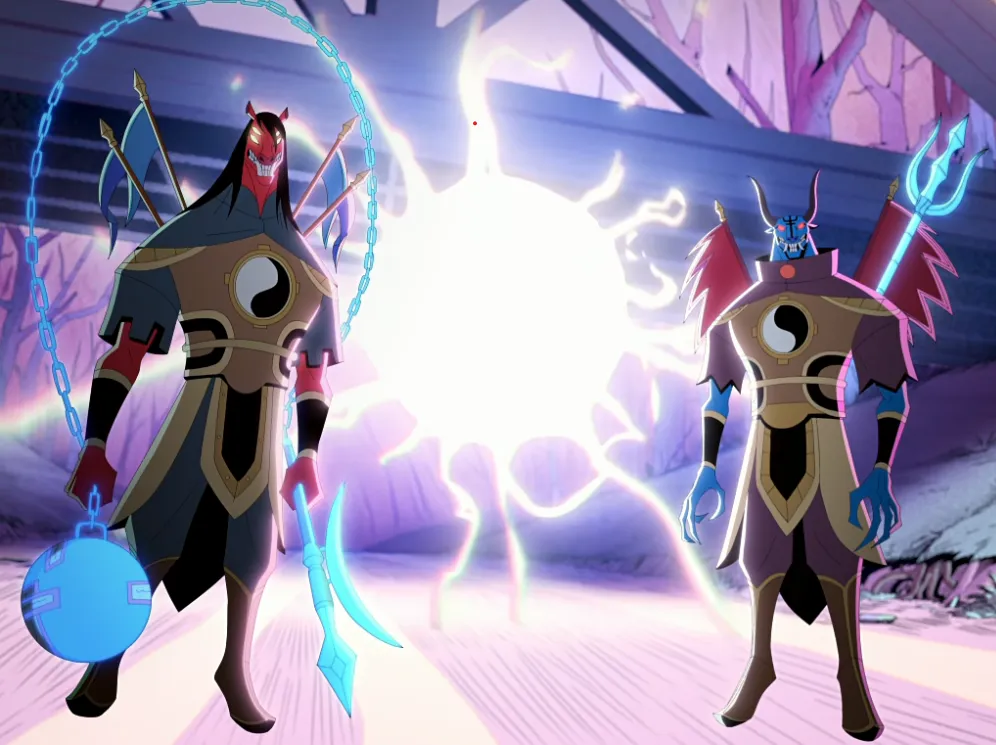 Keeping their muscular, well-built forms, battle armour and heavy weaponry, their faces have been stylised into fanged demons complete with glowing eyes. Ox-Head’s curved horns have been straightened, lengthened and made more satanic, while Horse-Face’s small ears are complimented by four glowing eyes, and a mane made to resemble the flowing black locks of ancient Asian warriors. To this is added the kaoqi flags on their backs, worn in Chinese opera to signify the presence of military generals. If that’s not badass enough, the gangcha and tielian they wield glow and crackle. They hold a screen presence to match, bristling with formidable power, they turn up at Jentry’s house to warn her in no uncertain terms, that the portal must be closed. Albeit harsh, these guardians are fair, and honour their agreement not to engage in battle as long as she closes the portal. What is furthermore satisfying is their reverse blue/red colour schemes that at once signify their closeness, complementariness, and subtly nod to their former mortal personalities, the blue Ox-Head being the hardworking and level-headed one, and the red Horse-Face, flamboyant and flashy.
In all honesty, these two aren’t really supposed to be the beings that hunt stray souls through the mortal world, a role traditionally assigned to the Hei Bai Wuchang, two ghoulish hunters, one dressed in black with white detailing, the other in white with black detailing. They do appear in Diyu briefly, but for a pair with such a popular role in Chinese pop culture, especially with the LGBTQ element they can bring, sidelining them felt like a majorly missed opportunity (and perhaps something they could return to and remedy in a second season?)
That said, I was blown away by the sheer number of mythical beings we know so well, to see them on an English series on Netflix was, years ago, a mere dream. Bai Suzhen, also known as White Snake, appears briefly in the story as a mentor to one of the main antagonists. As a supernatural serpent from classical theatre, she and her sister spirit, Xiaoqing, gained popularity via classic films and TV such as Green Snake (Tsui Hark, 1993), Legend of White Snake (Tsu-hui Hsia, 1992) and the more recent two Light Chaser donghua.
The tiger-like Pixiu that guard Flora Chau’s secret room help to bring some light-hearted humour. Retaining their traditional fierceness as devourers of evil spirits, the show has turned them into miniature guardians with a cheeky attitude, who speak the systems language for logging into a website, rather than unsealing a mystic door. As they already have that comic core of them, with an origin story of devouring treasures and poor house training, leading an exasperated celestial ruler to erase their buttholes, they make the very model of secure storage. Flora’s secret room contains more notes to Chinese mythology, from the golden robes of Yandi (responsible for Jentry’s power/curse), to the flaming wheels and sash of Nehza. It quickly comes an eye-spy of references and easter eggs.
In part two, we’ll look at food, C-pop, and of course, the monsters.
Posted in Articles and tagged Chinese, demons, Emmy's, fantasy, ghosts, horror, Jentry Chau, mythology, Netflix, occult, SFF, spirits, TV, underworld, YA